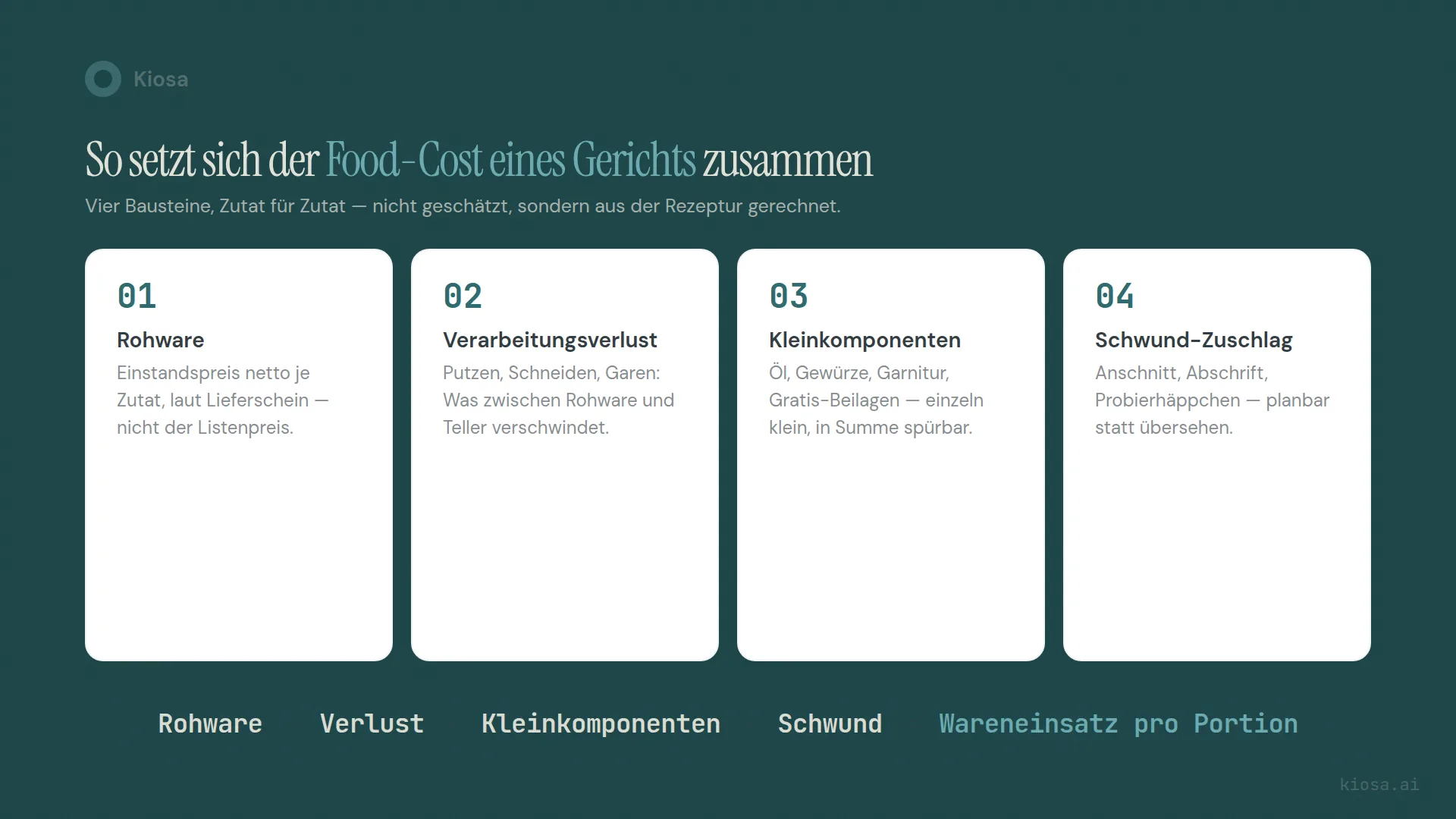
Food cost per dish is the recipe multiplied by current purchase prices, plus trim and cooking loss, plus an allowance for small components and shrinkage. If you work through these four items consistently instead of estimating, you know the real cost of every plate. Only then can you set a sensible menu price. At month end, you check the sum of all costed plates against the food cost of the whole business.
This article covers exactly that preliminary step: how to determine the food cost of a single dish cleanly and repeatably. Pricing itself — pricing multiplier, target food cost percentage, contribution margin — is covered in detail in restaurant menu pricing: from food cost to menu price. Here, we focus on what has to happen first for that calculation to be right at all.
Contents
- What belongs in recipe costing?
- The recipe as a bill of materials: what goes on the ingredient list
- Purchase price: net or gross?
- Why food cost is higher than the ingredient list suggests
- Worked example: from purchase price to food cost per portion
- Portion discipline: the silent margin killer
- How do you deal with fluctuating purchase prices?
- 5 typical costing mistakes at ingredient level
- FAQ
- Your next steps
What belongs in recipe costing?
Recipe costing and menu pricing are often mixed up in practice, but they are two different calculations answering two different questions. Pricing asks: what does the dish need to cost for the business to pay its way? Recipe costing asks something more fundamental: what does this dish actually cost to produce — per portion, in euros and cents?
The second question comes first. Without a reliable food cost per dish, any pricing is guesswork, however elegant the formula that follows. The food cost ratio for the whole menu is only as good as the individual recipe costings it is built from. If a kitchen works with outdated or estimated numbers for ten out of thirty dishes, the month-end percentage is fiction with three decimal places.
What belongs in clean recipe costing is manageable: the complete ingredient list with quantities, the current purchase price of each ingredient, a realistic loss factor for trimming, cutting and cooking, and an allowance for what is hard to break down to individual ingredients — shrinkage, offcuts, tasting. Four items. Most businesses capture two of them.
The recipe as a bill of materials: what goes on the ingredient list
Manufacturing uses the term bill of materials: the complete, quantity-accurate list of every component of a product. A recipe is nothing else — except that in the kitchen, the sheet too often says "a little oil" or "a pinch" instead of a number.
Three categories belong on every ingredient list, and two of them are regularly forgotten:
The main components. Meat, fish, vegetables, dough — the obvious items that usually do get recorded.
The small components. Frying oil, spices, herbs, garnish, the dollop of crème fraîche. Each one costs cents. Across a menu of forty dishes and thousands of portions a month, it adds up to an amount that appears on no line of the P&L, because nobody costed it.
Free sides. The bread basket that lands on the table automatically. The fries with the burger that aren't charged separately. These items belong, proportionally, in the costing of the main dish they're served with — otherwise they simply vanish from the calculation even though they cost money.
A recipe that is documented by eye rather than weighed is, strictly speaking, not a basis for costing. It is a memory aid for the chef.
Purchase price: net or gross?
Always net. Sales tax (VAT) is a pass-through item you hand on to the tax authority — it doesn't belong in your cost calculation, neither on the purchasing side nor on the selling side.
More important than the net-or-gross question, though, is another distinction that causes more errors in practice: the landed cost is not the list price. The list price is in the supplier's catalogue. The landed cost is what actually appears on your delivery note, after discounts, rebates, minimum-order terms and any freight charges. There can be several percentage points between the two — and if you cost with the list price, you're working with the wrong cost: usually too high, but too low where freight or small-order surcharges apply.
The same applies the other way round: one-off promotions a supplier uses to tempt you don't belong in your standing costing. If you cost a recipe at a promotional price and buy at the regular price three months later, you have a dish on the menu that was priced too cheaply from day one.
Why food cost is higher than the ingredient list suggests
This is where most recipe costings quietly go wrong — not through a calculation error, but through a forgotten line. Raw product is almost always heavier than what ends up on the plate. Fish has skin and bones. Vegetables have peel, stalks and stems. Meat has fat, sinew and trimmings. And even cleanly trimmed product keeps losing weight during cooking, as liquid and fat escape.
This difference between purchase weight and portion weight is called yield, and it decides whether your costed food cost matches reality or only exists on paper. The formula isn't complicated:
Cost per usable kilo = net purchase price ÷ (1 − loss rate)
If you buy a kilo of an ingredient for €20 and lose 15 per cent of the weight during trimming and cooking, a kilo doesn't cost you €20 — you pay €20 for 850 grams of usable product. Converted to the usable kilo, that's €23.53, not €20. That difference multiplies with every portion sold, week after week.
How big the loss actually is for a given ingredient can't be stated for the whole industry — product quality, cut and preparation vary too much. That's exactly why a generic table from the internet doesn't really help. What helps is a one-off weighing in your own kitchen: record the raw weight, record the trimmed and cooked weight, and enter the difference as a factor in the recipe. Once done, the factor holds until the supplier, quality or preparation changes.
Worked example: from purchase price to food cost per portion
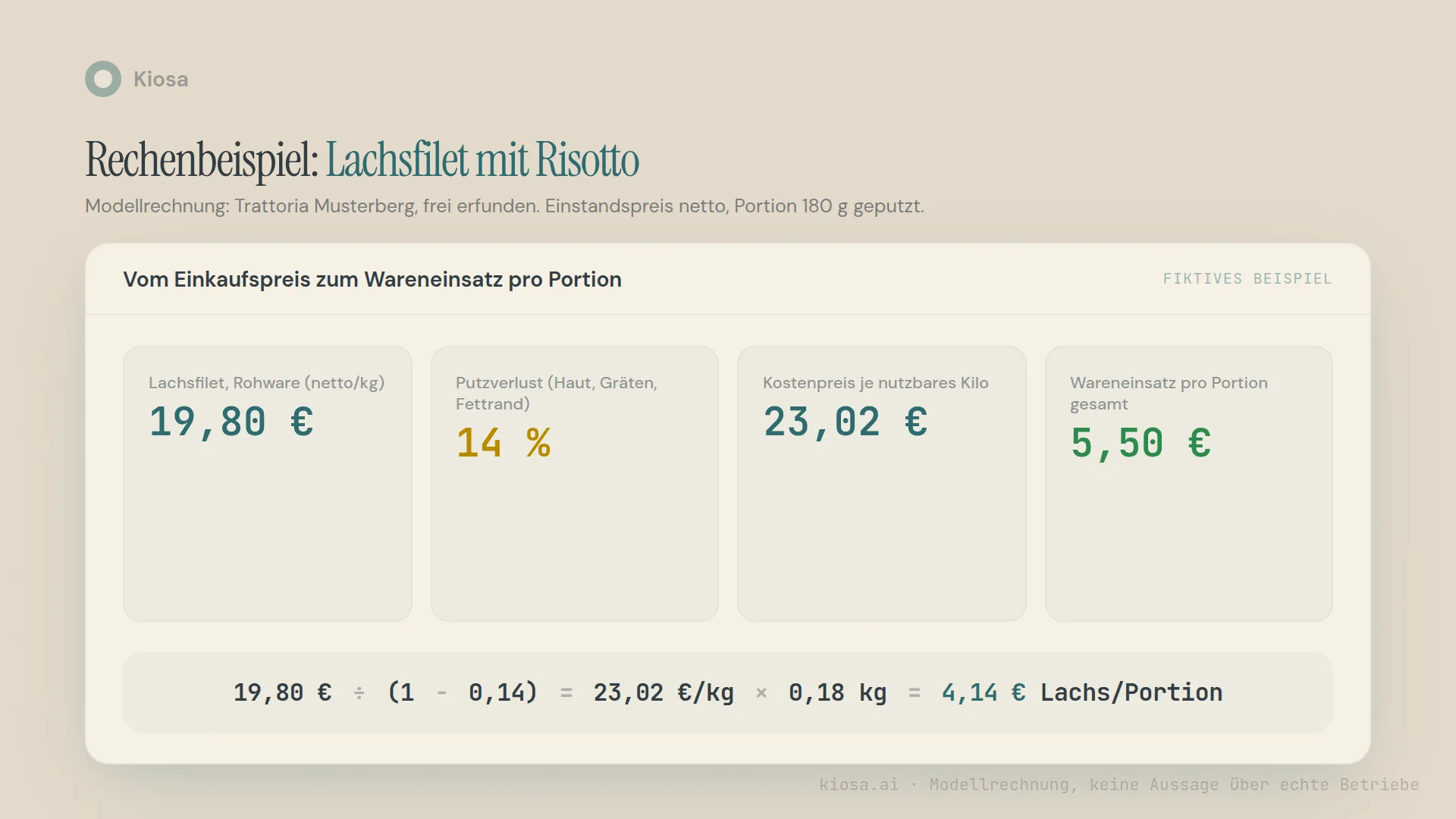
One dish, fully costed. Model calculation, "Trattoria Musterberg", entirely fictional — no statement about real businesses.
Salmon fillet with risotto. The kitchen buys skin-on salmon fillet at €19.80 net per kilo. During trimming — removing the skin, pin-boning, cutting off the fat line — the fillet demonstrably loses 14 per cent of its weight in this kitchen.
| Item | Calculation | Amount |
|---|---|---|
| Salmon fillet, raw product (net/kg) | purchase price | €19.80 |
| Trim loss (skin, bones, fat line) | 14% | — |
| Cost per usable kilo | €19.80 / (1 − 0.14) | €23.02 |
| Salmon per portion (180 g trimmed) | €23.02 × 0.18 | €4.14 |
| Risotto (rice, Parmesan, butter, stock, white wine) | recipe | €0.95 |
| Garnish, herbs, olive oil | recipe | €0.20 |
| Small shrinkage allowance (4% on total) | €0.21 | |
| Total food cost per portion | €5.50 |
€5.50, not the €4.14 that a costing without loss calculation and without the side would show. The gap between the two numbers is exactly what happens when recipe costing only sees the main ingredient. For one dish it may look like a detail. Across forty dishes and several thousand portions sold a month, it's a number that shows up in the P&L — only nobody knows where it comes from.
Portion discipline: the silent margin killer
The cleanest costing is worthless if the kitchen doesn't stick to it. The most common mistake I see in businesses that have costed their recipes properly isn't the costing itself — it's execution at the stove. The Margherita is costed with 180 grams of mozzarella. For months, the chef has been putting on 220 grams because it looks better and nobody objects. The costing on paper stays at 180 grams. Reality is 40 grams more expensive, on every single portion.
That isn't bad intent. It's what happens when portioning relies on feel instead of scales or portion scoops, and when nobody regularly checks whether what the kitchen actually uses still matches the stored recipe. This gap between costed theoretical and actual usage is covered in detail in actual vs. theoretical food cost: where your money disappears — the logical next step once the basic costing is in place.
Three things help in practice. Portioning aids that leave no room for interpretation — scales, portion scoops of a defined size, pre-portioned bags for critical ingredients. Regular retraining, especially after staff changes in the kitchen. And a routine that makes deviations visible before they creep in over months.
How do you deal with fluctuating purchase prices?
A recipe costing that is created once a year and then left alone goes stale faster than most businesses realise. Meat, fish and vegetable prices fluctuate with the seasons and the market, sometimes by double digits within a few weeks. A costing from spring says little about actual costs in autumn.
Two things have to work together: a fixed rhythm in which recipes are checked against current purchase prices, and a system that notices price changes at all, instead of only uncovering them at the next manual check. If you only keep purchase prices in your head or in Excel, you usually notice a price rise when food cost has already visibly increased in the P&L — looking back, not ahead.
This is exactly where Kiosa comes in: supplier invoices arrive in the system by email, purchase prices flow into recipe management, and when a price changes, the dish costing recalculates automatically. The purchase-price watcher reports noticeable increases as soon as they happen, not at the next costing round. At every stock count, the theoretical-vs-actual comparison shows where the costed recipe deviates from what was actually used. Recipe costing stays a living foundation rather than a document that was right at some point.

5 typical costing mistakes at ingredient level
Mistake 1: Recipes only exist in the chef's head. No written, weighed documentation means every chef does it differently and every shift implicitly re-costs the dish. Recipe costing without a documented recipe isn't costing — it's a snapshot.
Mistake 2: Trim and cooking loss are ignored. The costing uses the purchase weight, not what actually ends up on the plate. Food cost is therefore systematically too low — on every single portion.
Mistake 3: Small components and free sides are missing. Oil, spices, garnish, the bread basket. Inconspicuous one by one, but across the menu and the year an amount that appears in no costing yet is missing from the till.
Mistake 4: Purchase prices aren't kept current. Last year's recipe costing is a historical document, not a steering tool. If you don't keep entering price changes, you're costing against a reality that no longer exists.
Mistake 5: List price instead of landed cost. Discounts, rebates and special terms aren't reflected in the costing, even though they noticeably shift the actual price per kilo — in both directions.
From analysis to action
What this is about: costing food cost per dish properly, including trim and cooking loss.
Put it into practice: Recipe management in Kiosa Inventory
More on Food cost and inventory
- Food Cost Percentage Formula: Calculation, Example, Calculator
- Restaurant Menu Pricing: From Food Cost to Selling Price
- Actual vs Theoretical Food Cost: Formula and Worked Example
FAQ
What is the difference between recipe costing and menu pricing?
Recipe costing determines what a dish actually costs to produce — ingredient by ingredient, including loss and small components. Menu pricing uses this result as the basis for deriving a selling price via a pricing multiplier or target food cost percentage. Without clean recipe costing, pricing has no reliable foundation.
How do I calculate food cost per dish?
Record all ingredients in the recipe with quantity and current net purchase price, factor in the trim and cooking loss per ingredient, add small components and a proportional share of free sides, and add a small allowance for minor shrinkage. The total is the food cost of that one portion.
What is trim or processing loss?
The weight difference between the raw product you buy and what is actually usable after trimming, cutting and cooking — such as skin and bones in fish, peel and stalks in vegetables, fat and sinew in meat. If this loss isn't factored in, the costed food cost is systematically lower than the actual one.
How often should I re-cost my recipes?
At least twice a year in full, and quarterly or continuously for volatile purchase prices — fish, meat or seasonal vegetables, for example. If you connect purchasing data directly to the system, you no longer re-cost by the calendar; you see price changes as they happen.
What belongs in the food cost of a dish?
The main ingredients at current landed cost, small components such as oil, spices and garnish, a proportional share of free sides, an allowance for trim and cooking loss per ingredient, and a small buffer for offcuts and minor shrinkage. If you only cost the main ingredient, you regularly underestimate your food cost.
Your next steps
Food cost calculator – Recalculate the food cost of your dishes including loss and shrinkage allowances, with your own purchase prices.
Actual vs. theoretical food cost – The next step once your recipe costing is in place: check whether your actual usage still matches the costing.
Restaurant menu pricing: from food cost to menu price – From clean recipe costing to the selling price: pricing multiplier, target food cost percentage and contribution margin in detail.
30 minutes well spent. Want purchase prices per dish to come automatically from your supplier invoices instead of recalculating them by hand every quarter? Book a demo call – I'll show you what that looks like with real data.
Related terms
- Food cost ratio – formula and benchmarks for the food cost percentage
- COGS – cost of goods sold, and how the term differs from the food cost percentage
