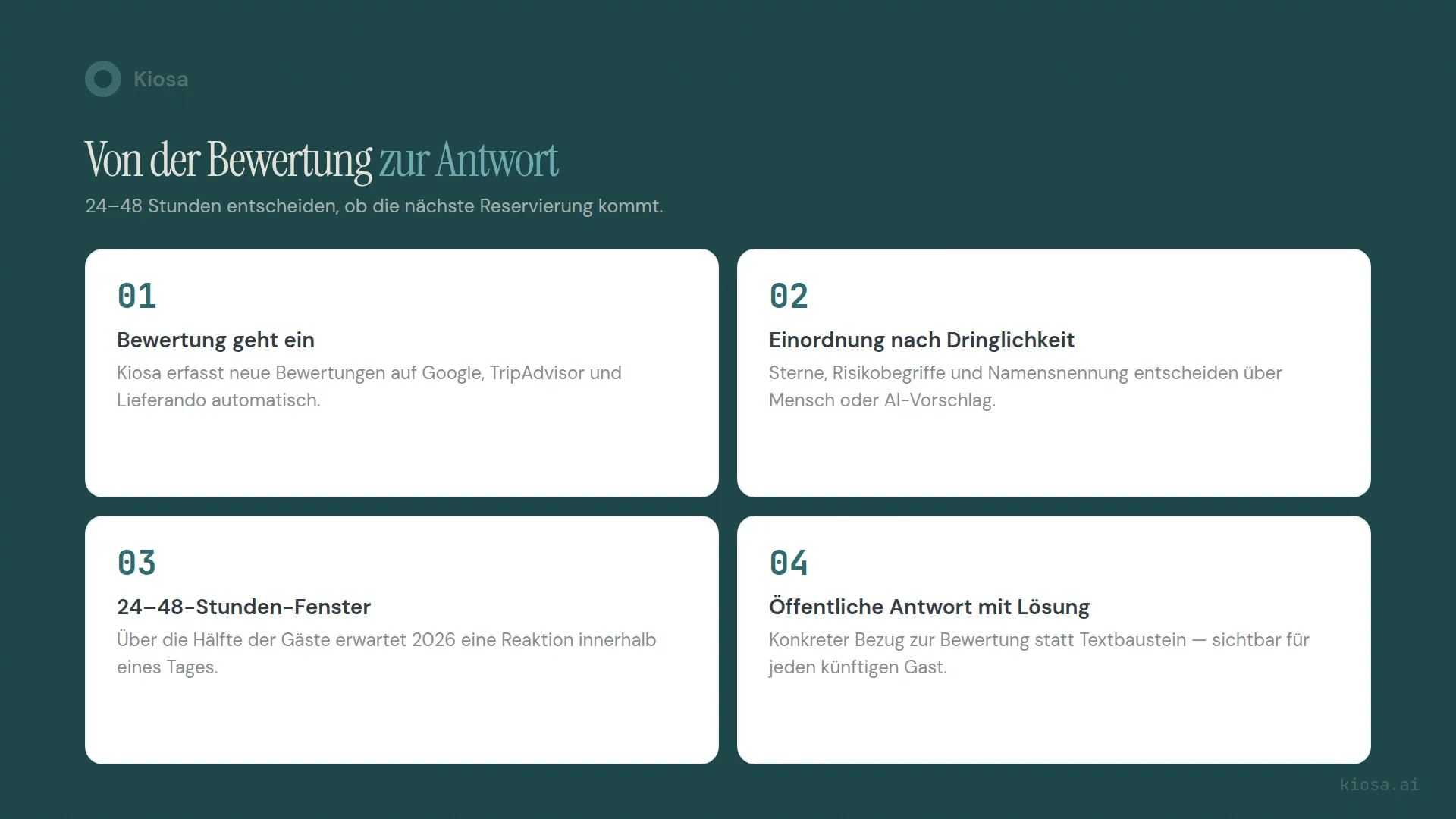
Respond to every Google review publicly, within 24 to 48 hours, with a concrete solution instead of a stock phrase. According to an Ipsos/TripAdvisor study, 63 percent of guests are more likely to book with operators who respond to most of their reviews. Kiosa One View collects reviews from the connected platforms and drafts replies with AI that you approve. By default, only 5-star reviews without text are answered automatically, and only if you switch that on; critical reviews stay with you. Replies are only one of five factors AI assistants use to judge your restaurant, though; the rest are covered by the 15-point checklist for your Google Business Profile.
AI is changing how fast a reply is possible. Who is accountable for it stays the same. This guide gives you four templates to copy and a clear line for where the machine has to stop.
Table of contents
- Why do 24 to 48 hours decide the next booking?
- What does Google officially say about responding to reviews?
- Which template fits which review?
- When may AI reply, and when does a human have to step in?
- What does this look like in Kiosa One View?
- FAQ
- Your next steps
Why do 24 to 48 hours decide the next booking?
In 2019, Ipsos MORI surveyed more than 23,000 travellers and diners on behalf of TripAdvisor. The result: 63 percent would be more likely to book a hotel or restaurant if the operator responds to most of its reviews. With personal, individual replies, the figure rises to 77 percent (Ipsos/TripAdvisor via PR Newswire, December 2019, accessed 2026-08-24). The study isn't a snapshot from this year, but the order of magnitude matches newer data.
BrightLocal's Local Consumer Review Survey 2026 (a survey of US consumers) shows how expectations have tightened since: 19 percent now expect a reply to their review on the same day, up from 6 percent a year earlier. Another 32 percent expect a reply by the next day (previous year: 18 percent). Together that is just over half who consider a response by the next day at the latest to be normal (BrightLocal, Local Consumer Review Survey 2026, accessed 2026-11-10). If you take two to three days, you are already at the upper edge of what guests will accept.
The same study adds the trust factor: 80 percent of respondents are more likely to use a business that responds to all its reviews. At the same time, quality beats quantity: generic phrases like "Thanks for your feedback" put off 50 percent of readers, because they signal automation without real interest.
That is the core of the problem this article solves. You need speed — 24 to 48 hours, public, tied to the specific review. And you need substance, not a stock phrase. Delivering both at once, across three, five or ten locations, is where most businesses give up. Not because a single reply is hard. Because it comes up every single day.
What does Google officially say about responding to reviews?
Google itself is cautious about specific deadlines. Its official help page on managing customer reviews recommends, in essence, replying in a constructive and friendly way and showing appreciation for the feedback — there are no harder rules than that (Google Business Profile Help, Manage customer reviews, accessed 2026-08-24). Not a word about automated replies, no deadline. The expectation comes from guests, not from the platform.
Inappropriate reviews are a different matter. Google lets you report them via a "Report" button next to the review, with categories such as spam, offensive language or conflict of interest (Google Business Profile Help, Report inappropriate reviews, accessed 2026-08-24). The key point is the restriction Google makes in the same document: a review is only removed if it violates the policies — not because it is negative. Accurate but uncomfortable criticism stays up, even if it hurts. Reporting is meant for spam, fake accounts and hate speech. Not for the guest who rightly mentions the long wait.
This distinction matters for the templates below. With an unfair review you have two levers: report it (if it breaks the policies) and reply publicly (always). The two don't exclude each other, but only the second lever is fully in your hands.
Which template fits which review?
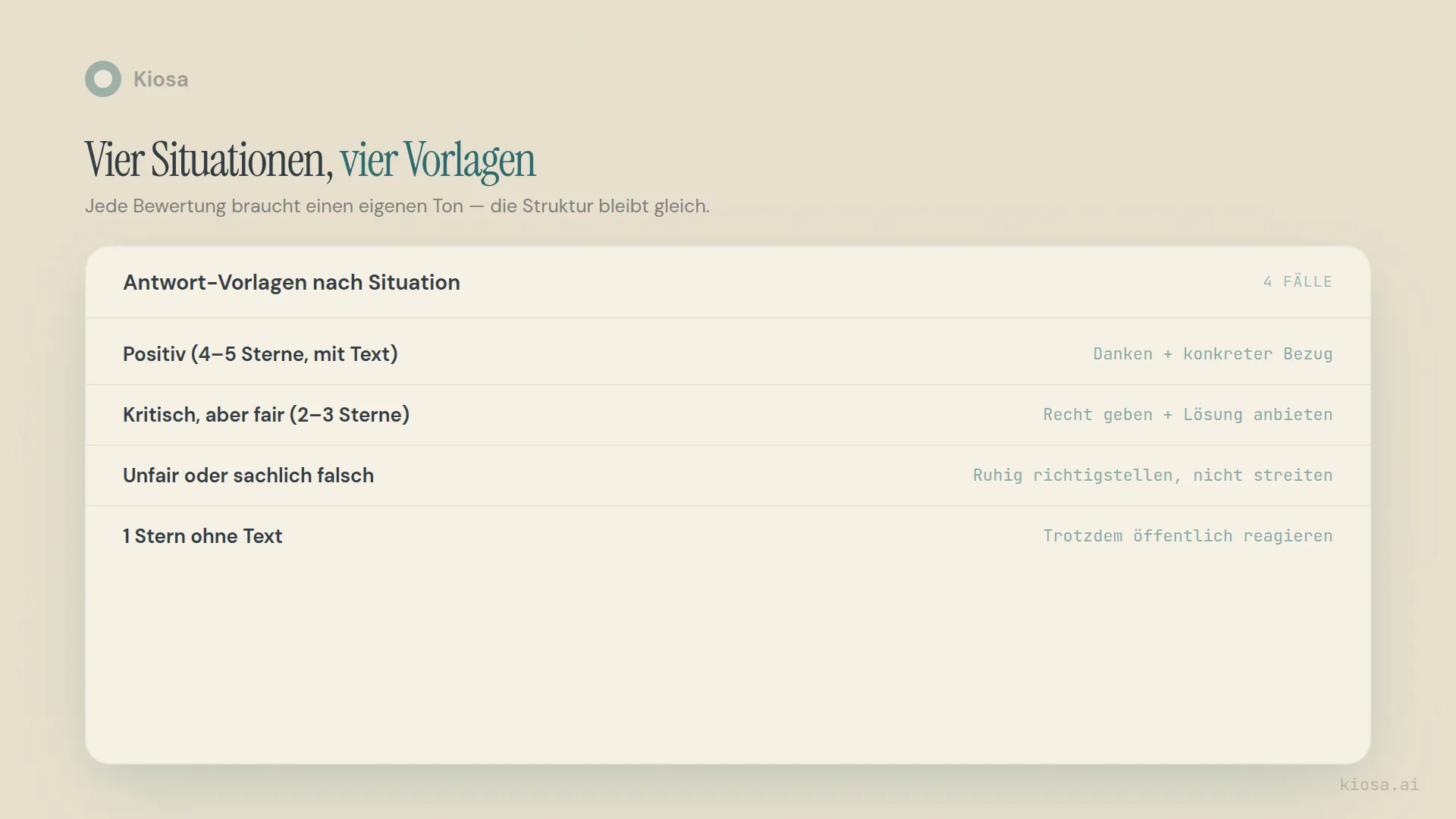
Four situations come up regularly in every restaurant. The templates below are frameworks, not copy-paste final products — replace the brackets with what the specific review actually says. A reply that obviously has nothing to do with the text it answers looks worse than no reply at all.
1. Positive review (4–5 stars, with text)
Hi [name], thank you so much for the kind words! We're especially pleased that you enjoyed [specific detail from the review, e.g. the dish of the day / the service from XY]. We'll happily pass the praise on to the team and look forward to your next visit.
Keep it short. The usual mistake with positive reviews is length, not tone. One sentence of thanks, one sentence referring to the content, done.
2. Critical but fair review (2–3 stars, specific criticism)
Hi [name], thank you for taking the time to share this feedback. We're sorry that [specific point of criticism] didn't meet our standards. That's not the experience we want to deliver. We have [specific action, e.g. "briefed the kitchen team" / "discussed waiting times with the service team"]. If you'd like to give us a second chance, please get in touch directly at [contact] — we'd love the opportunity to win you over.
The difference from an unfair review: you concede the point before you offer a solution. No "but", no justification in the first sentence.
3. Unfair or factually wrong review
Hi [name], thank you for your feedback. We've looked into your account internally and [specific, factual correction without accusation — e.g. "according to our records, we had no booking under this name on the evening mentioned" / "the situation described doesn't match how we operate"]. We take every piece of feedback seriously and invite you to contact us directly so we can clear this up together: [contact].
Don't argue in public, don't make accusations. The correction is for the future guests reading along, not for a debate with the author. If the review breaks Google's policies (wrong business, fake account, hate speech), also submit it via the Report button — that doesn't replace the public reply, it complements it.
4. One star, no text
Hi, we're sorry your visit didn't win you over. We'd like to understand what went wrong so we can improve — could you briefly tell us what happened at [contact]? We'll take the time for it.
The hardest category, because it gives you nothing to work with. Reply anyway, and reply publicly. A 1-star review without comment and without any reaction from the operator reads to the next prospective guest like an undisputed accusation.
When may AI reply, and when does a human have to step in?
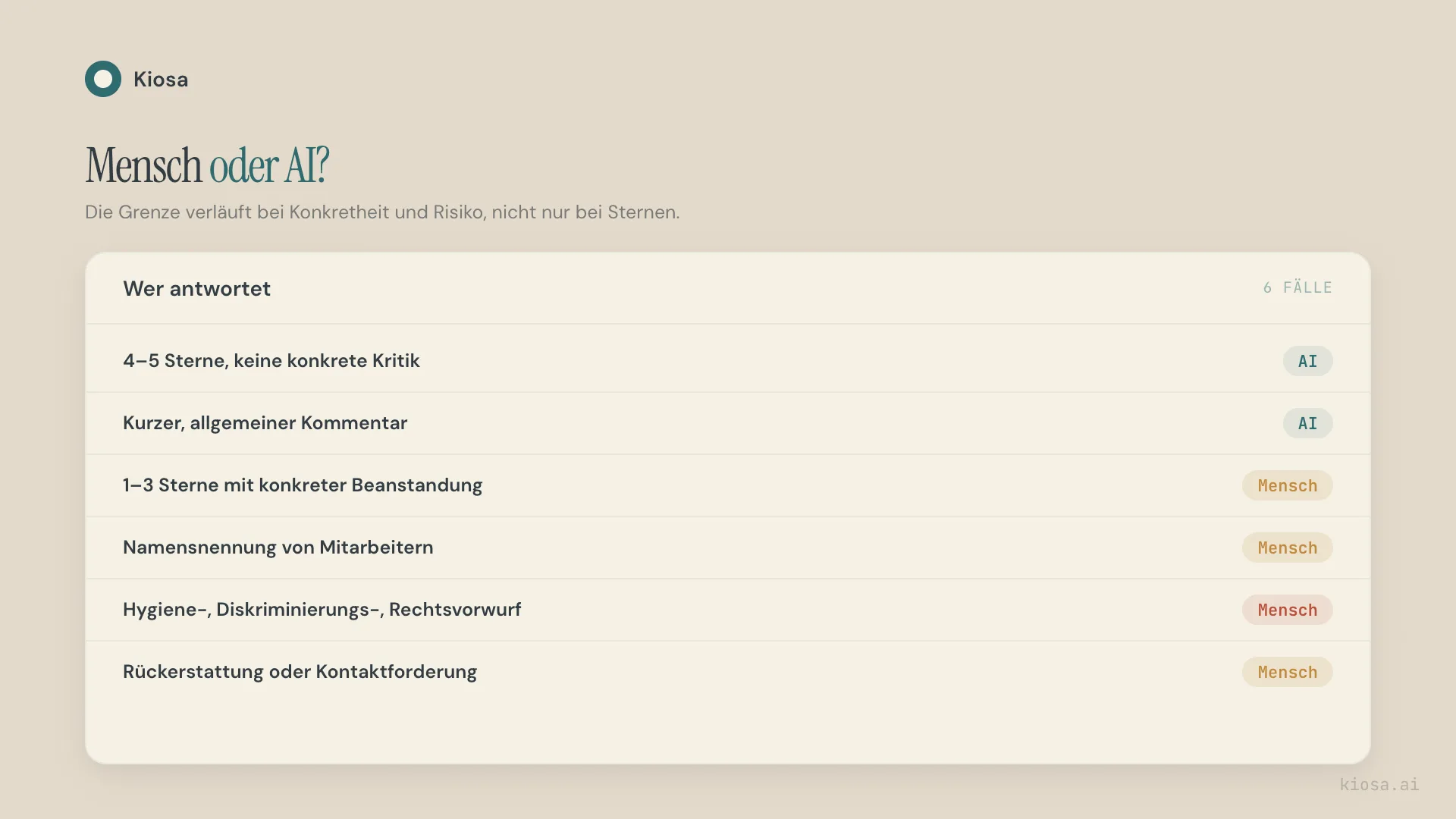
AI systems can fill in the templates above in seconds. The question isn't whether that works technically — it's for which cases you're willing to carry the risk of an automated reply. The line isn't drawn by stars alone, but by specificity and risk.
AI may reply automatically to:
- 4- and 5-star reviews without a specific complaint
- Short, general comments that don't name individual employees
- Recurring, uncritical phrases ("delicious", "friendly service")
A human has to step in for:
- Every review with 1–3 stars and a specific complaint
- Mentions of individual employees by name (positive or negative)
- Allegations about hygiene, food safety, discrimination or harassment
- Demands for a refund or direct contact
- Reviews that are obviously wrong or refer to the wrong business
- Any review with an aggressive tone or a threat of legal action
The reason for this line isn't distrust of the technology, but liability and tone. A badly worded AI reply to a hygiene allegation can turn a harmless individual opinion into a documented admission. A praise review without risk has no such downside — speed is all that counts there, and the machine can deliver it without anyone watching.
Kiosa One View maps this line to a setting: by default, the AI suggests a reply for reviews with text, and you approve or edit it. Only 5-star reviews without text are answered automatically there, using a fixed template, and only if you switch that on for the location. Kiosa also emails you about reviews with one or two stars. Every AI reply is checked before it is published; promises of discounts or vouchers, for example, never go out. Whether and where more should run automatically is your decision. Not the machine's.
What does this look like in Kiosa One View?
Checking three to five platforms by hand every day is hard to sustain once you run several locations. Not because a single reply is difficult, but because it comes up again every day and is the first thing to slip in daily operations. That's where review reporting and POS reporting are alike: both need a fixed rhythm, not ad-hoc attention.
Kiosa One View collects reviews from all connected platforms (Google plus delivery platforms such as Lieferando, Wolt and Uber Eats) in one place, sorts them by urgency and lets you reply to Google reviews straight from the feed. The feature is part of the One View module (€99 per location per month, part of the modular Kiosa stack — fully built out €445 per location per month, no setup fee; see pricing). For reviews with text, the AI provides a draft reply that you approve or edit. Critical reviews with one or two stars also reach you by email, with context instead of a silent notification.
The result isn't that you read fewer reviews. The result is that you focus your time on the cases where a human actually makes a difference — while the standard cases sit in front of you with a finished draft, without you opening five tabs every morning.
From analysis to action
What this is about: answering Google reviews quickly and safely, and where the line sits between an AI draft and a human reply.
Put it into practice: Reviews from all connected platforms in Kiosa One View
More on Guests and online visibility
FAQ
Do I have to respond to every Google review?
Yes, if you can afford to do it consistently. According to BrightLocal (2026), 80 percent of consumers are more likely to use a business that responds to all its reviews. Better to respond consistently to every review than only to the negative ones — otherwise it looks like damage control rather than genuine interest.
How quickly do I need to respond to a Google review?
Within 24 to 48 hours. BrightLocal (2026) shows that more than half of consumers now expect a reply within a day, a rising share compared with the previous year. If you take longer than a week, you're outside what most guests still consider normal.
Can I get an unfair review removed if it doesn't break the policies?
As a rule, no. According to its own help pages, Google only removes reviews that violate its policies (spam, fake accounts, hate speech, wrong business). Uncomfortable but plausible criticism stays up, even if it feels unfair. In that case, a public correction counts for more than a removal request.
What should I do with a 1-star review that has no text?
Reply publicly anyway. Without text you have no starting point for a specific explanation, but an unanswered 1-star review reads to the next prospective guest like an uncontested accusation. A short offer to sort out the issue personally is enough.
Can AI answer Google reviews fully automatically?
Technically yes, but it only makes sense for uncritical cases. By default, Kiosa One View only answers 5-star reviews without text automatically, and only if you switch that on. For all other reviews, the AI drafts a reply that you approve.
Your next steps
- Measure your current response time. Open your Google profile and look at the last five reviews: how long did the reply take? Over 48 hours is your most urgent lever.
- Save the four templates as text snippets. In your phone's notes or as a shared document for the team — as long as they're at hand when a new review comes in.
- Check whether a review actually breaks Google's policies before you invest time in a report. For accurate but uncomfortable criticism, a public reply is worth more than an attempt to get it removed.
- See Kiosa One View live. The connected platforms in one place, AI reply drafts for approval, a clear line for critical reviews. Book a 30-minute demo call and we'll show you what it looks like for your business.
Related terms
- Anomaly detection — automatic detection of unusual patterns against the expected trend, as useful in the review feed as with POS data
- Average check — average sales per check or transaction, the numbers counterpart to the public review
Further reading
- Google Business Profile for restaurants — the 15-point checklist for the complete profile; review replies are only one of five factors
- Restaurant POS data analysis
- Restaurant financial controlling: the daily rhythm
- Menu item sales analysis — rating menu items by sales volume and contribution margin
