Specialised restaurant inventory management costs around €130 to €175 per location per month with the providers we compared; with Kiosa, it's €49 as an add-on module to One View (€148 together). The real question is at what business size it pays off. In this article's model calculation, the tipping point is usually 2 to 3 locations, because from then on nobody sees every delivery note personally. You'll best understand what a system takes off your hands if you calculate food cost once by hand.
Contents
- What a restaurant inventory management system actually does
- What manual ordering and stock control really cost
- What an inventory management system costs
- At what business size an inventory management system pays off
- How the process works in Kiosa
- Where Kiosa Inventory stands — and what it doesn't replace
- FAQ
- Your next steps
What a restaurant inventory management system actually does
An inventory management system connects three things that run separately in most businesses: what you order, what is actually delivered, and what food cost your recipes call for. It doesn't replace the POS — it connects to it. The POS remains the source of sales data; the inventory system links this data with recipes, supplier prices and stock levels.
In concrete terms: an order suggestion is generated automatically from quantities sold and recipes, not from the head chef's gut feeling. The delivery note is checked against the order, not just signed and filed. And theoretical food cost, meaning what your recipes should have used according to the costing, is set against actual usage.
The most common mistake I see in multi-location businesses: ordering and food cost control stay in two separate worlds. Orders go to the supplier via WhatsApp. The costing sits in an Excel file nobody has updated for months. Each works tolerably on its own. Together, they create exactly the gap an inventory management system is meant to close.
Food cost and labor cost together make up prime cost, the largest cost block, long before rent and energy even come up. Food cost is the second big lever after labor, and it is exactly what an inventory management system tackles directly. If you know both percentages but not why they turn out the way they do, you only have half the answer.
What manual ordering and stock control really cost
When sales are under pressure, every percentage point of food cost that is lost unnoticed weighs more heavily.
The honest answer: manual inventory management doesn't cost nothing. It costs time nobody books, and errors nobody sees until the stock count shows the total.
Without a system, control typically works like this: the delivery note is skimmed briefly at goods receipt, not checked line by line against the order. The food cost calculation happens once a month in Excel, if at all. Variances only become visible at the next stock count — weeks after they occurred. With a system, it works the other way round: order suggestion from usage and forecast, delivery note matched to the invoice, recipe costs updated daily, variance visible with the next count.
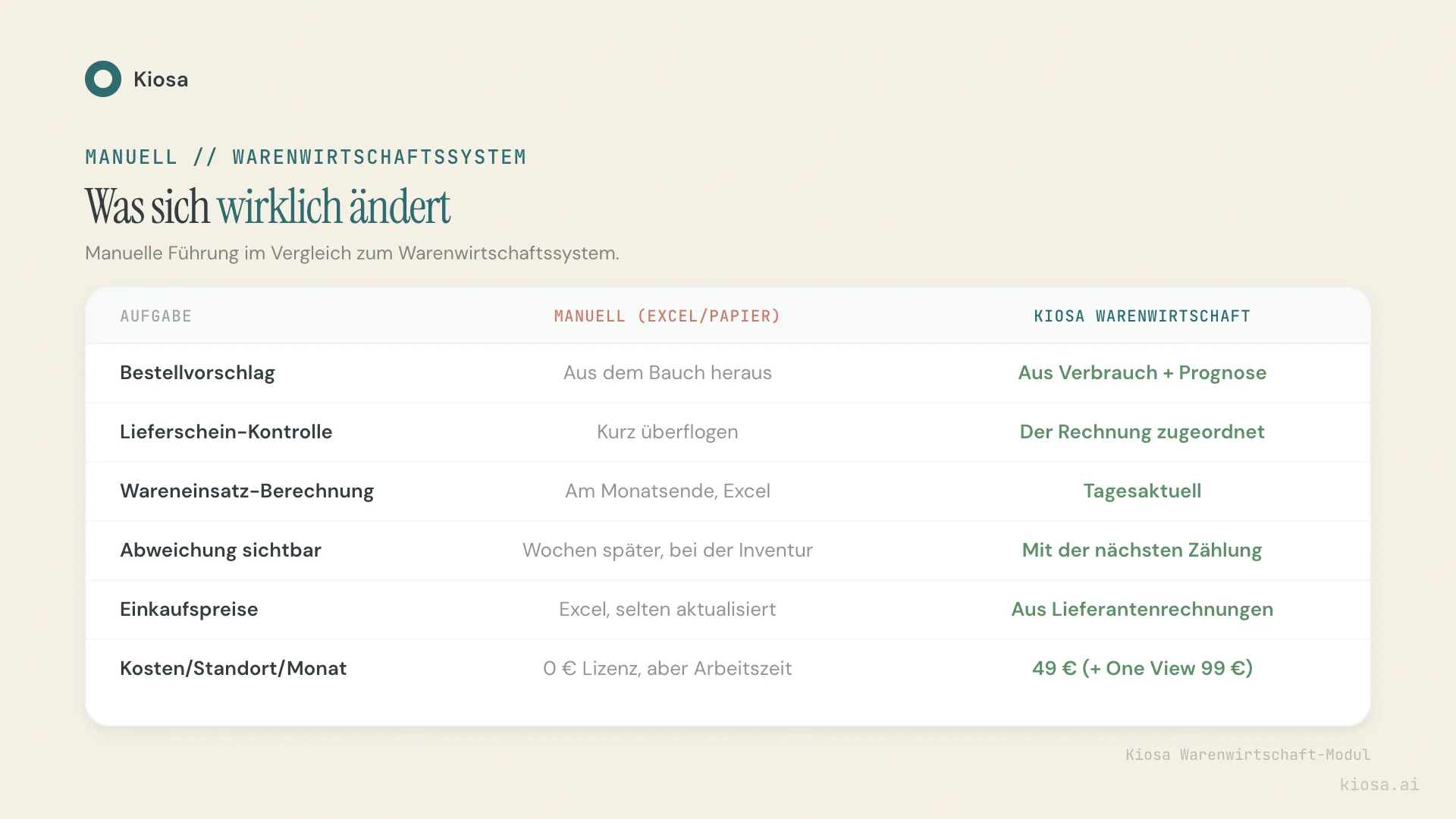
The difference is rarely the price of the software. It's the point at which a variance is noticed. A system that only reacts at the stock count finds the total. A system that reconciles continuously finds the cause — while someone still remembers what happened on Tuesday.
What an inventory management system costs
Among the providers compared in our restaurant software overview, entry prices for specialised inventory management are around €130 to €175 per location per month. The breakdown by provider, including setup costs and multi-location surcharges, is in that overview — I won't repeat the table here, because it changes faster than this article can stay current.
Kiosa offers inventory management as a module in its modular pricing, as of November 2026:
| Module | Price per location/month |
|---|---|
| One View (POS and staff in one data basis, daily P&L, AI partner) | €99 |
| Inventory (stock count, theoretical-vs-actual comparison, recipe costs, order suggestions) | €49 |
| Invoices (document capture, delivery note matching, accounting export, costs flow into the P&L automatically) | €99 |
| Loyalty (regulars app, push, customer retention) | €99 |
| Scheduling (AI rota, shift planning, payroll export) | €99 |
| Full stack | €445 |
No setup fee. You add the Inventory module to One View; you don't need the other modules for it: One View and Inventory are enough for order suggestions and the theoretical-vs-actual comparison. With the Invoices module, documents and delivery notes arrive in Kiosa by email.
At what business size an inventory management system pays off
For a single-location business, the question of business size is more of a nice-to-have than an urgent matter. For anyone running more than one location, it quickly becomes very real.
This is where it gets interesting, and where I have to be honest about what follows: it's a model calculation with an invented business, not an analysis of real numbers. The values are chosen to be plausible, not measured.
Take a fictional model business, "Osteria Nordlicht", with €650,000 annual sales per location. The assumption: without systematic control, a variance arises between theoretical and actual food cost that grows with the number of locations — not because individual locations get worse, but because one person can no longer see every delivery note personally.
With one location, the owner usually still manages it themselves: model assumption of 0.5 percentage points variance on sales, which comes to €3,250 a year. With three locations, there isn't enough time for the same density of control: model assumption of 2.5 percentage points per location, which comes to €48,750 a year across all three. With six locations, personal control practically collapses: model assumption of 4 percentage points per location, which comes to €156,000 a year.
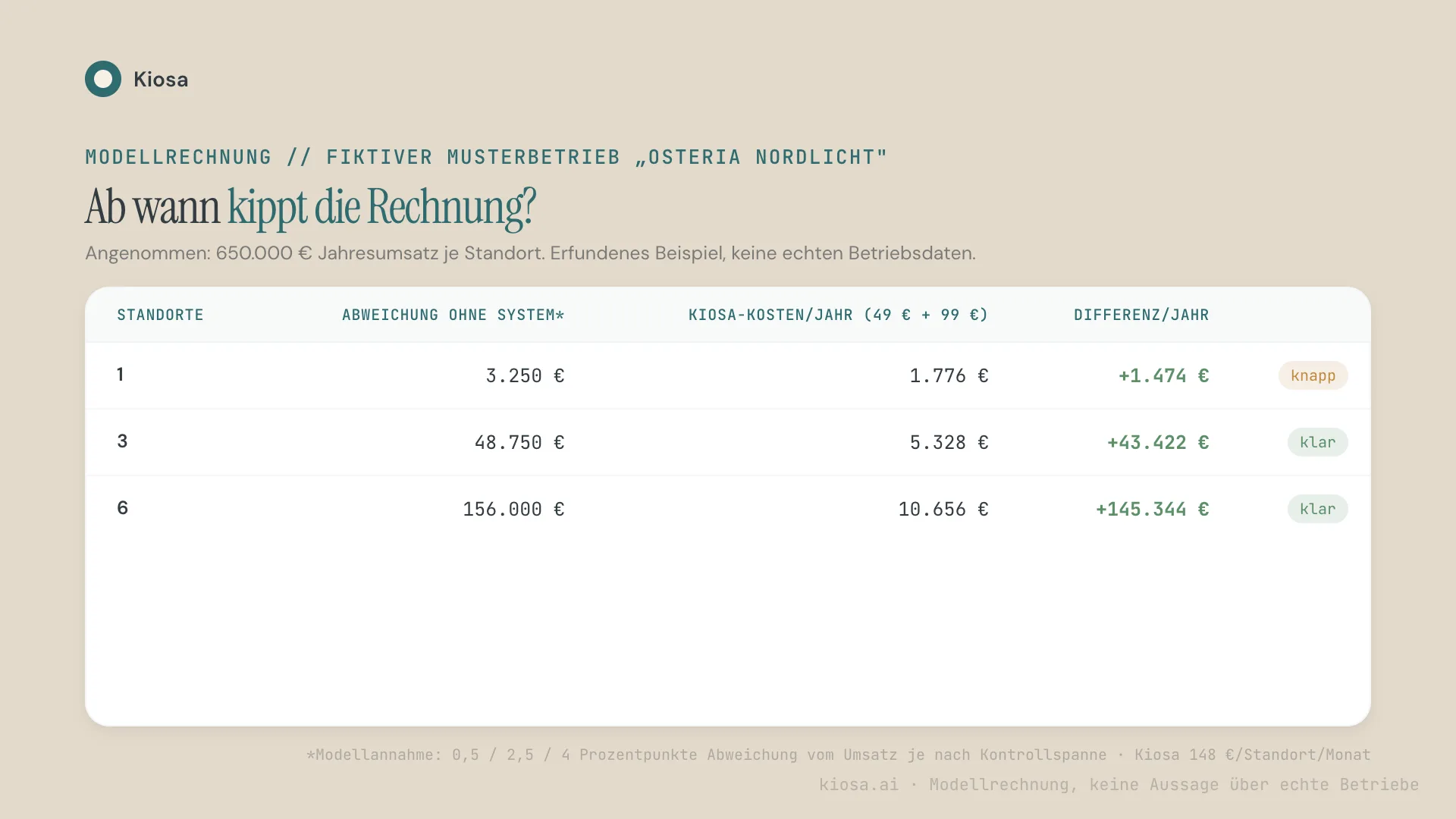
Against this stand the costs of €49 (Inventory) plus €99 (One View, which supplies the POS data) per location per month, so €148, and €1,776 a year per location. With one location the calculation is tight: a model benefit of €1,474 a year, but maintaining recipes and connecting suppliers takes setup time that this benefit first has to earn back. With three locations the calculation is no longer tight — it's clear-cut. With six locations, the question has long stopped being about cost and become whether anyone still knows where the money goes.
That matches what I see in practice again and again: a single location lives from the owner's presence. As soon as a second or third location is added, that presence is spread thinner — and that's exactly the moment the variance starts to grow, unnoticed, because nobody sees every delivery personally any more.
How the process works in Kiosa
The process has four steps, and none of them replaces your existing POS.
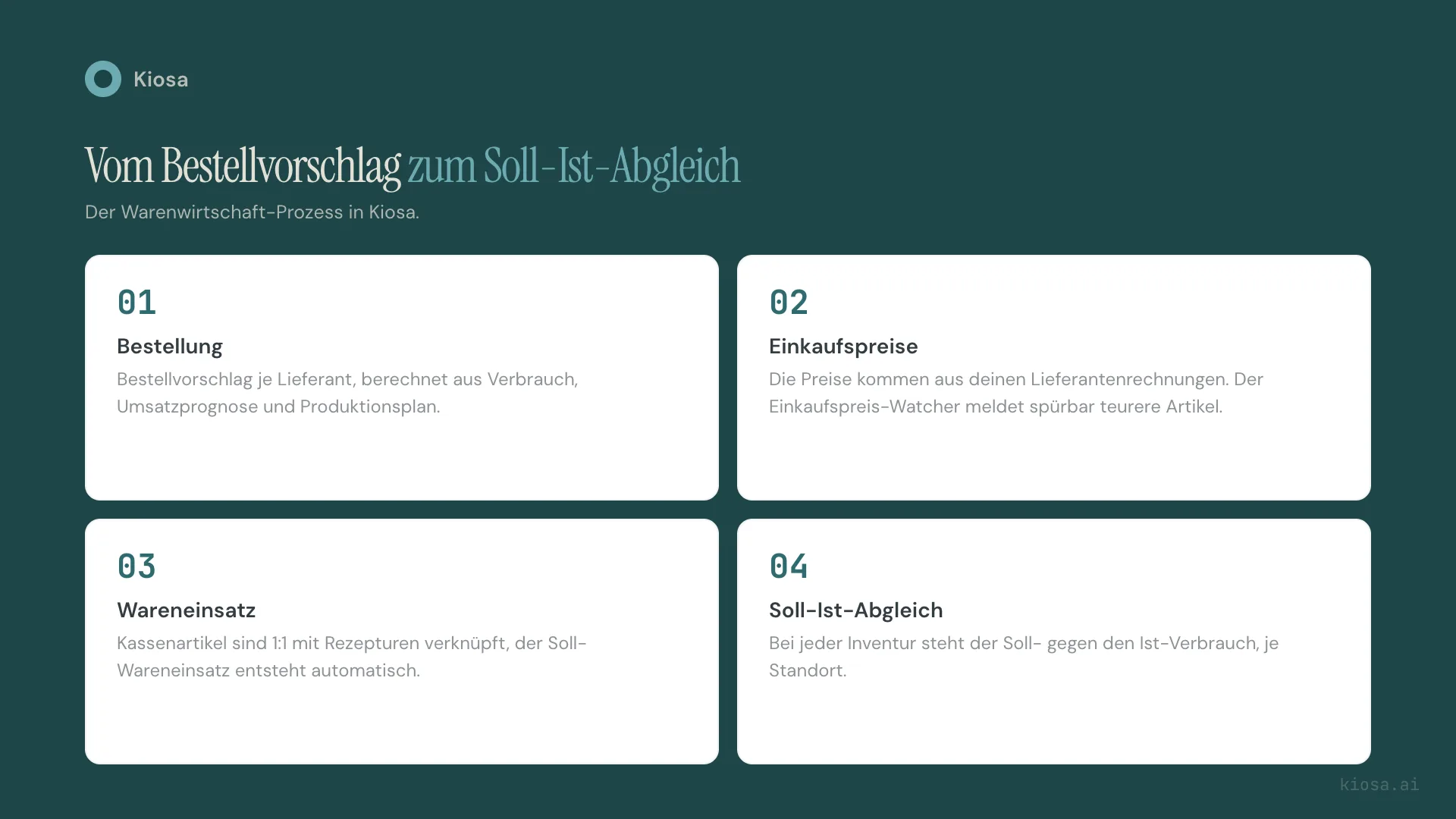
Ordering. The order suggestion per supplier is generated from usage, sales forecast and production plan — not from the experience that "we needed roughly this much last week too".
Purchase prices. Prices come from your supplier invoices. The purchase-price watcher reports when an item gets noticeably more expensive, and the dish costing updates automatically.
Food cost. POS items are linked 1:1 to recipes — not at category level such as "pizza", but at the level of individual dishes. Theoretical food cost is calculated from this automatically, afresh every day.
Theoretical-vs-actual comparison. At every stock count, theoretical and actual usage are compared per location; the dashboard shows when a count is overdue. Until stock data is complete, purchase and recipe values provide early signals. That shortens the time between "something's not right here" and "we know what it was".
If you want to know how big your own gap between theoretical and actual food cost is right now, the food cost calculator gives you a first estimate in a few minutes, without introducing any software.
Where Kiosa Inventory stands — and what it doesn't replace
Kiosa Inventory is a module, not a standalone ordering system with a supplier marketplace. You keep ordering from your existing suppliers through your existing channels — the module organises what and how much you order, not from whom.
What the module does: stock count with theoretical-vs-actual comparison, theoretical against actual food cost, recipe management with cost per dish, AI-based production planning and order suggestions, purchase-price watcher.
What the module doesn't do: it doesn't replace a POS. You still need an existing POS that Kiosa reads (official integrations: OktoPOS or Hypersoft). It isn't a supplier marketplace and doesn't negotiate prices. And it doesn't replace a food cost percentage analysis from the ground up — that still needs maintained recipes, otherwise every analysis remains an estimate at category level.
If you already have a working Excel routine that keeps variances below one percentage point, you don't need to switch straight away. But if you run more than one location and have to admit honestly that nobody checks every delivery note individually any more, the decision has usually already been made for you — food cost is too big to manage on the side.
From analysis to action
What this is about: estimating the cost of an inventory management system and the break-even by number of locations.
Put it into practice: Kiosa Inventory: stock counts, recipe costs and order suggestions
More on Food cost and inventory
- Food Cost Percentage Formula: Calculation, Example, Calculator
- Restaurant Supplier Price Increases: How to Spot the Silent Ones
- Restaurant Recipe Costing: Food Cost per Dish, Step by Step
FAQ
From how many locations does an inventory management system pay off?
In this article's model calculation, the balance tips clearly in favour of a system once a business reaches 2 to 3 locations — the point at which one person no longer has personal control over every delivery note. For a single location, the answer depends on the size of the product range and the time actually available for manual control.
What does a restaurant inventory management system cost?
Among the providers compared in our restaurant software overview, specialised providers charge entry prices of around €130 to €175 per location per month, often plus a setup fee (details in the restaurant software overview). Kiosa offers the Inventory module for €49 per location per month, with no setup costs, as an add-on to One View (€99).
Does an inventory management system replace the POS?
No. An inventory management system connects to the POS but doesn't replace it. Kiosa reads sales data from your POS (official integrations: OktoPOS or Hypersoft) and links it with recipes, supplier prices and stock levels — the POS itself stays in use unchanged.
What is the difference between food cost percentage and a theoretical-vs-actual comparison?
The food cost percentage shows what percentage of your sales you spent on stock — a snapshot. The theoretical-vs-actual comparison sets this figure against what your recipes should have used according to the costing, and shows whether the percentage is well costed or an unnoticed variance. More on this in the article on actual vs. theoretical food cost.
Can I use an inventory management system with only one location?
Technically yes; there's no minimum size. Whether it pays off depends on the product range and your own time. If you run a single business and first want to check how big your own gap between theoretical and actual food cost is, the food cost calculator gets you a first number without introducing any software. It's also worth thinking about shrinkage at this point, because it's part of the same variance.
Your next steps
Want to know whether inventory management already pays off for your business? Book 30 minutes and we'll work through your number of locations and your product range together: book a call.
Want to see a first number before you commit? The food cost calculator shows you in a few minutes where your food cost percentage stands today — no contract required.
And if you're interested in how a single percentage point of variance translates into real money: the article on actual vs. theoretical food cost works it through in detail.
As of November 2026. Market prices for inventory management systems are based on providers' publicly available pricing pages; details in the restaurant software overview. The "Osteria Nordlicht" model calculation is an invented example for illustration, not a statement about real businesses. Found an error? hello@kiosa.ai — we'll correct it.
